Winter Excavation in IL and Iowa: Frost Depth and What Can Be Dug
Every year around the first hard freeze, the same question comes up from homeowners, farmers and builders in the Quad Cities region: is it too late to dig? The honest answer is "it depends on the job." Frozen ground does change how excavation work gets done in Henry County, Rock Island County and Scott County, but it does not shut everything down. Knowing how deep frost really goes, and which projects tolerate it, helps you plan a winter schedule that makes sense instead of losing months waiting for spring.
How Deep Does the Ground Actually Freeze Here?
There are two different "frost depth" numbers, and people often mix them up. The first is the depth the ground actually freezes in a given winter. The second is the depth that building codes require foundations and footings to reach.
The actual number varies a lot from winter to winter. The Illinois State Climatologist's office has described a study of frost depth observations collected by cemetery workers over 16 winters (1980 to 1996). The deepest frost observed in that period ranged from about 5 inches in far southern Illinois to about 30 inches in far northern Illinois. The same study found that ground frost generally shows up in northern Illinois by late November and lasts until mid-March or early April. Henry and Rock Island Counties sit in the northern part of Illinois, and Scott County is just across the river, so a freeze-up in late fall and a thaw in March is the normal rhythm.
Weather in the Quad Cities backs that up. At the Moline airport, the 1991 to 2020 climate normals show the daily low dropping to or below freezing on about 17 days in November, about 27 days in December and about 29 days in January. Average snowfall is roughly 9 inches in December, 11 inches in January and 9 inches in February.
Snow cover matters more than most people expect. Research from the National Research Council of Canada notes that each foot of undisturbed snow reduces the depth of soil freezing by about that same amount, and that frost generally reaches deeper in silty and sandy soils than in clays. A bare, windswept field or a plowed driveway can freeze much deeper than a snow-covered lawn right next to it.
Why Codes Still Say 42 Inches
Footings have to sit below the depth where frost can heave them, and codes use a conservative design number rather than the typical winter's frost. In Rock Island County, the county's published foundation guidance calls for footings at least 42 inches below final grade. Scott County, Iowa lists 42 inches for the footings of uncovered decks. Other towns and counties set their own value when they adopt the residential code, so always confirm the figure with your local building department before you design or dig.
That design depth is also why buried water lines and many utility trenches are dug deep. Pipes that sit above the frost line can freeze, and footings that sit above it can move.
What Changes When You Dig Frozen Ground
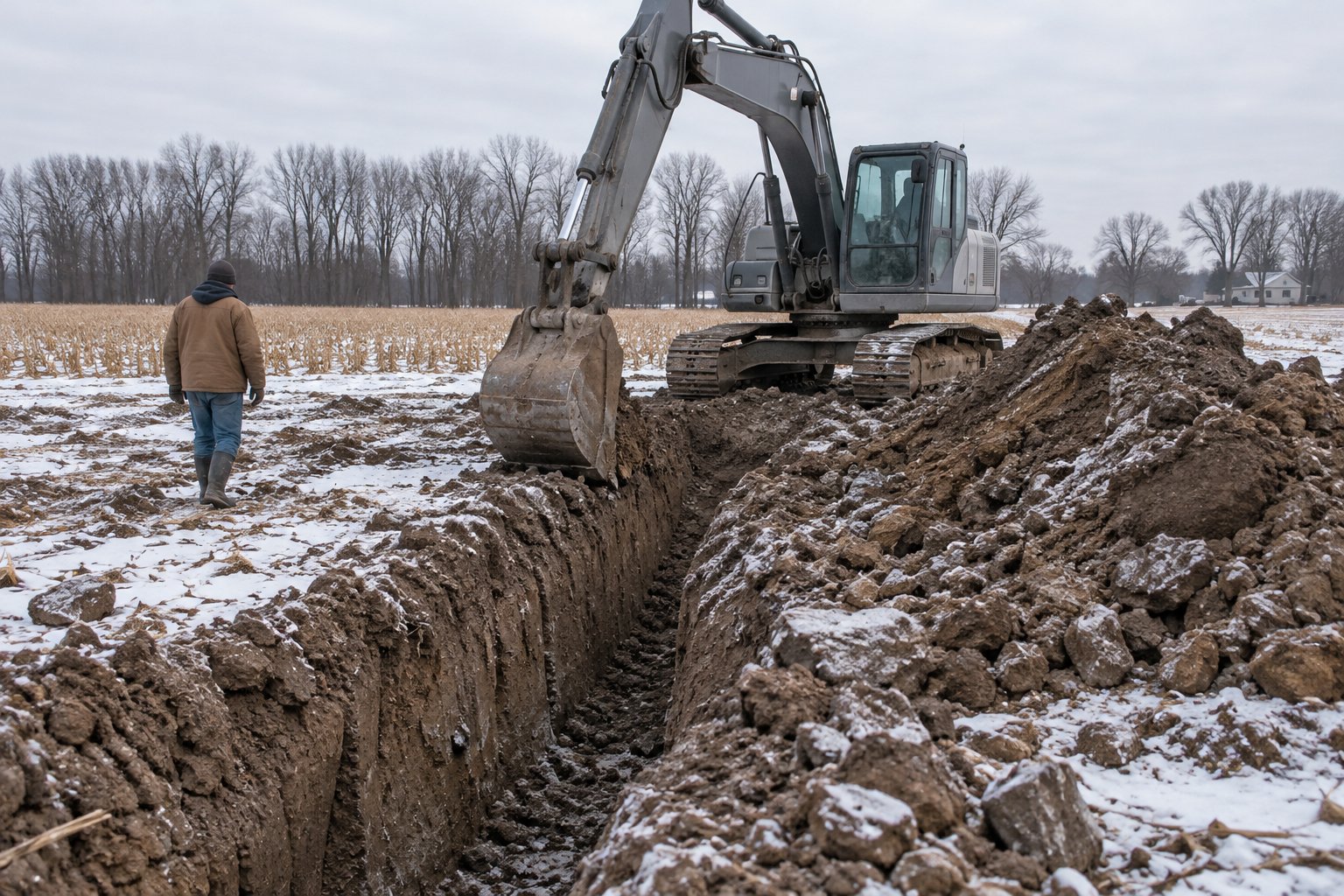
Frozen soil behaves more like rock than like dirt. Cold-region research from the U.S. Army Corps of Engineers describes frozen ground as one of the hard-ground conditions that give problems to conventional, unassisted equipment, which is why ripper attachments and heavier machines are used on it. The frozen layer sits on top of unfrozen soil, so once equipment breaks through it, the soil underneath is usually workable.
The bigger issue is what happens next. Frozen lumps do not compact. Winter construction guidance for buried structures says to haul only unfrozen backfill, keep snow and ice out of the fill zone, and compact right after placing it. If backfill is placed frozen or full of ice, it can settle badly when it thaws, and that shows up later as a sunken trench line, a cracked slab or a dip in a driveway.
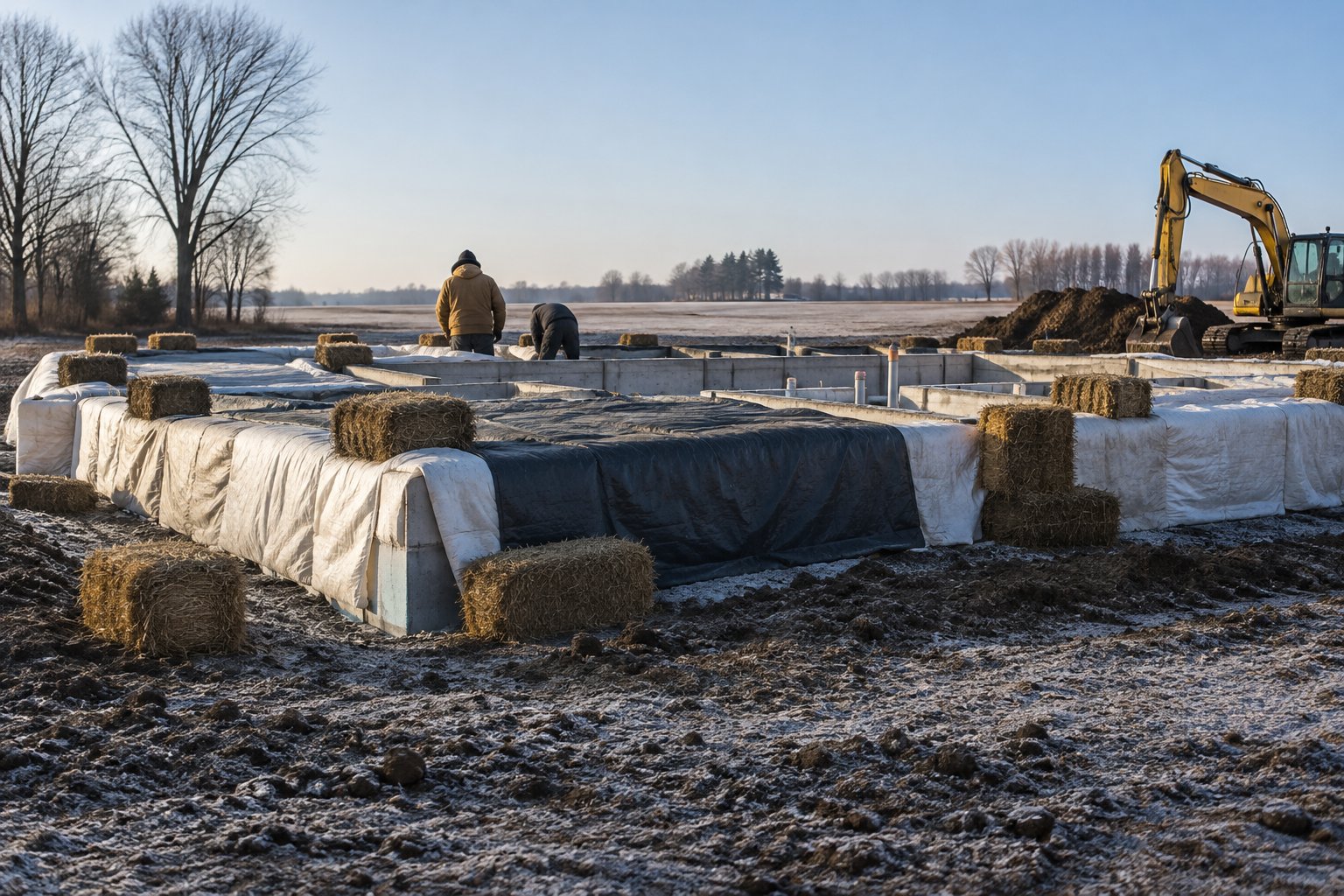
Concrete is the other limiting factor. The American Concrete Institute defines cold weather concreting as any time the air temperature is at or expected to fall below 40 degrees Fahrenheit during the protection period, which means footings, slabs and flatwork need heated, covered or otherwise protected placement. Many projects are better scheduled so the excavation happens now and the concrete follows when the weather allows.
Projects That Often Work in Winter, and Ones That Usually Wait
Every site is different, so treat this as a starting point for a conversation rather than a rule:
- Often workable: emergency sewer or water line repairs, utility trenching, demolition, and early excavation for a foundation or basement when the footings and concrete can be protected from freezing.
- Often workable as planning steps: site walks, staking, utility locates, soil evaluations, permit applications and measuring for drainage fixes, so the project is ready to start the moment the ground cooperates.
- Usually better to wait: septic drain field construction, finish grading and seeding, and anything that depends on soil that is not frozen or saturated. Researchers at the University of Minnesota's onsite sewage program note that soil should not be frozen at the surface where wastewater will be absorbed, because smearing can occur under those conditions.
If you are not sure which category your project falls into, we can talk through it. We handle residential and commercial excavation, basement and foundation excavation, trenching, drainage work, septic installation and sewer repair across Henry, Rock Island, Knox and Mercer Counties in Illinois and Scott County, Iowa.
Do Not Skip the Utility Locate Just Because It Is Cold
Frozen ground and snow make it harder to see where lines might run, not easier. Illinois law requires anyone digging to submit a locate request to JULIE at least 2 days before the work starts, not counting the day of the notice, regardless of the depth or size of the project. Illinois tickets can be placed no more than 10 days ahead. In Iowa, the Iowa Utilities Commission says the request should be made at least two days before digging, excluding weekends and legal holidays, and the notice stays valid for 25 calendar days. In both states, you wait for the marks before breaking ground. Plan the call into your schedule, because a winter storm can easily push a start date.
Frequently Asked Questions
How deep is the frost line in the Quad Cities area?
There are two answers. The ground in a typical winter freezes to a fraction of the code depth, and the amount changes with snow cover, soil type and how cold the winter is. The code depth that footings must reach is commonly 42 inches in this region, but it is set locally, so check with your building department.
Do I still need to call 811 in winter?
Yes. Digging notification rules in Illinois and Iowa apply all year, even for a small job and even when the ground is frozen. Your excavator should confirm the ticket and the marks before any digging begins.
Can concrete be poured in cold weather?
It can, but it needs a plan. Once the air temperature is at or expected to fall below 40 degrees Fahrenheit, concrete should be protected while it gains strength. Ask whoever places the concrete how it will be protected before you commit to a date.
Can a septic system be installed in winter?
The soil absorption area is the delicate part, because soil that is frozen or saturated can be damaged during construction. Some county health departments restrict winter installation or require approval, so ask your local health department about timing before you plan around it.
Planning a project for this winter or early spring? Contact us through our quote page and we will help you work out what can be done now and what should wait for the thaw.


