
Licensed, Bonded & Insured | Family Owned & Operated
049-028103 IL | IL Pumping License: 054-021753 | IA Pumping License: 12839
25 YRS. EXPERIENCE, FULL SITE PREP EXPERTS - HOW CAN WE HELP?
We Serve: Rock Island, Henry, Knox, or Mercer Counties in Illinois, and Scott County in Iowa
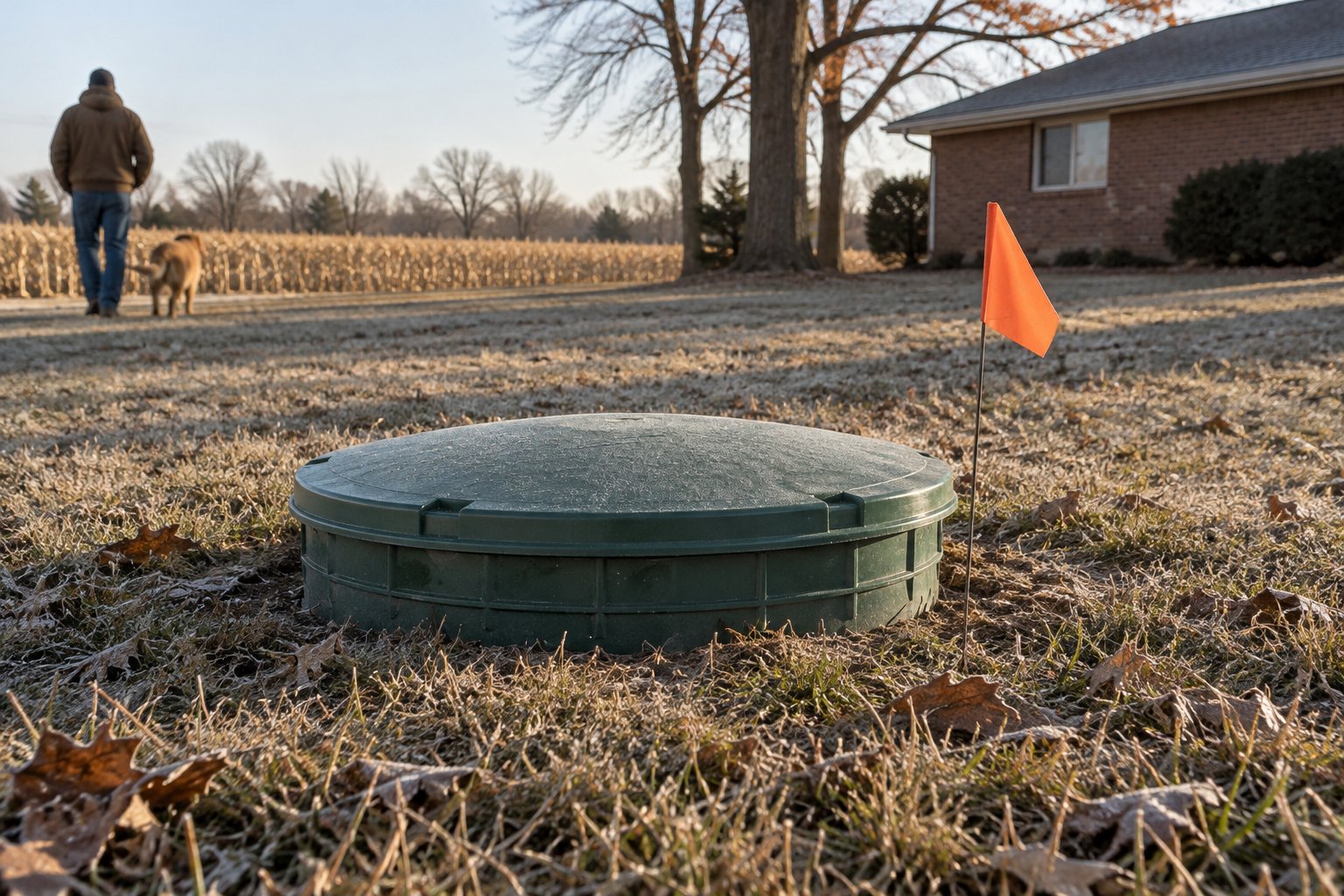
Find and Mark Your Septic Lid Before Snow Hits in Henry County, IL
A septic tank lid is easy to ignore in July. You know it is "somewhere near the back corner of the house," and that feels like enough. Then the ground freezes, a foot of snow covers the yard, and you realize nobody on the property can say exactly where the lid is. Finding a buried tank in January means probing frozen soil, shoveling in the cold and, sometimes, paying for extra time just to locate what should have been marked. A little work in the next few weeks avoids all of that, and it makes every future pump-out and inspection faster.
Why Winter Makes a Lost Lid Such a Problem
The U.S. EPA says a septic tank should generally be inspected every 1 to 3 years and pumped every 3 to 5 years, depending on tank size, the number of people in the household and how much water is used. That means at some point the tank needs to be opened. If the lid is under snow, or the soil above it is frozen, access becomes slower and harder for everyone.
Frost usually arrives in northern Illinois by late November and stays until mid-March or early April, according to long-term observations by the Illinois State Water Survey. In the Quad Cities area, Moline's climate normals show the daily low at or below freezing on about 17 days in November and about 27 days in December. In other words, the window to find and mark your lid with bare ground is open now and closing quickly.
There is also a second, quieter reason to know where the tank is. Snow is an insulating blanket for a septic system. The University of Minnesota's onsite sewage program explains that compacted snow insulates poorly and that driving equipment over a system compacts snow and pushes frost deeper. Knowing exactly where the tank, pipes and drain field are lets you and anyone who plows or shovels for you keep traffic off them all winter.
How to Find Your Septic Lid
Work through these steps in order, from least effort to most:
- Check your paperwork. The contractor who built the home may have given the first owner a map. Your closing documents or old maintenance receipts may also show a location or a sketch.
- Ask the county health department. Permits for private sewage systems in this region are handled by the local health departments, such as the Henry County Health Department, the Rock Island County Health Department and the Scott County Health Department in Iowa. University of Georgia Extension notes that a health department may have a sketch of a system's location and will provide it on request. Older systems may have incomplete records, so do not be surprised if there is nothing on file.
- Follow the sewer line. Go to the basement or crawl space and find where the main wastewater pipe leaves the foundation. UGA Extension says the tank is often located 10 to 20 feet outside the home, directly in front of that building sewer. A cleanout plug outside the house can also help.
- Probe carefully, after a locate. A thin metal probe can be used to feel for the top of the tank, but call 811 first so buried gas, electric and water lines are marked. Probe gently so you do not puncture pipes. This is much easier before the ground freezes.
If none of that works, a septic contractor can help you locate the tank. It is far easier to do this on a mild November day than after a deep freeze.
How to Mark It So You Can Find It Under Snow
Once you have found the lid, do not trust your memory. A few simple steps make the location permanent:
- Stake it above snow height. Use a tall, bright stake or marker flag on a pole that will stand well above a deep snowfall. Mark the tank lids, the distribution box if you know where it is, and the corners or direction of the drain field.
- Take measurements. Measure from two fixed points, such as two corners of the house, and write down the distances. Stakes can be knocked over by plows, kids and mowers, but corners of a house do not move.
- Take photos and make a sketch. Keep a labeled photo and a simple drawing with your septic records. Include your pump-out dates.
- Tell anyone who plows or shovels. Whoever clears your driveway should know which areas to avoid piling snow or driving across.

Is It Time for a Riser?
If your lid is buried a foot or more below the surface, you may want to ask about an access riser. The EPA's guidance on access risers says they help owners and inspectors easily locate the tank, and that they provide access for maintenance and repair without repeatedly digging up the lawn.
Current rules show how much the industry values easy access. The Illinois Private Sewage Disposal Code says that if the top of a septic tank is more than 12 inches below the ground surface, a riser must bring access over the inlet and outlet to within 12 inches of the surface. Iowa's rules for new tanks call for watertight risers with a minimum diameter of 18 inches to bring access openings to the ground surface, secured to deter tampering. Those rules apply to systems being built or replaced, so what your existing system needs may differ. Ask your septic professional or local health department what makes sense for yours.
Safety Around the Lid
Locating a lid is one thing. Opening it is another. State environmental agencies warn that you should never lean over a septic tank opening or put your head inside, because gases can overcome a person and someone can fall in. Lids and risers should be sound and secured so children and pets cannot move them. Leave opening and servicing the tank to a trained professional, and never drive over your tank or piping, because it can collapse. If you find a lid that is cracked, sunken or rusted through, treat it as a hazard right away.
Frequently Asked Questions
How far from the house is a septic tank usually?
University of Georgia Extension says the tank is often 10 to 20 feet from the house, directly in front of the building sewer. Your system may differ, especially if the home is older or the lot is large.
Can I dig up the lid myself?
Exposing a lid is a different matter than entering or opening a tank. Call 811 before you dig, keep the lid in place, and have a professional open and service the tank.
What if I cannot find my tank before it freezes?
Start with records from the county health department, then ask a septic contractor to locate it. Frozen ground and snow make this slower, but it is still possible.
How often should my tank be pumped?
The EPA says every 3 to 5 years in general, with inspections every 1 to 3 years. Your household size and water use change the right schedule.
If you cannot find your lid, or you want to talk through easier access for your tank, contact us through our quote page. We provide septic inspections, installation, repair and pumping across Henry, Rock Island, Knox and Mercer Counties in Illinois and Scott County, Iowa.


AVOID COSTLY MISTAKES:
Do NOT hire an excavating contractor without first reading our free guide:
The ULTIMATE Excavation & Septic "Success Guide."

We Offer Septic & Excavation Services Near You!
If you don't see your specific area, contact us and we may still be able to help or give a referral.
Address: 3359 N 1300th Ave, Orion, IL 61273
Hours:
Mon - Fri. 7:00 am - 5:00 pm (Closed Sat & Sun.)
Extended hours by appointment only.


All rights reserved | Privacy policy