Licensed, Bonded & Insured | Family Owned & Operated
049-028103 IL | IL Pumping License: 054-021753 | IA Pumping License: 12839
25 YRS. EXPERIENCE, FULL SITE PREP EXPERTS - HOW CAN WE HELP?
We Serve: Rock Island, Henry, Knox, or Mercer Counties in Illinois, and Scott County in Iowa
Pond Construction and Dredging: Why Late Fall Is Prime Time in Western Illinois
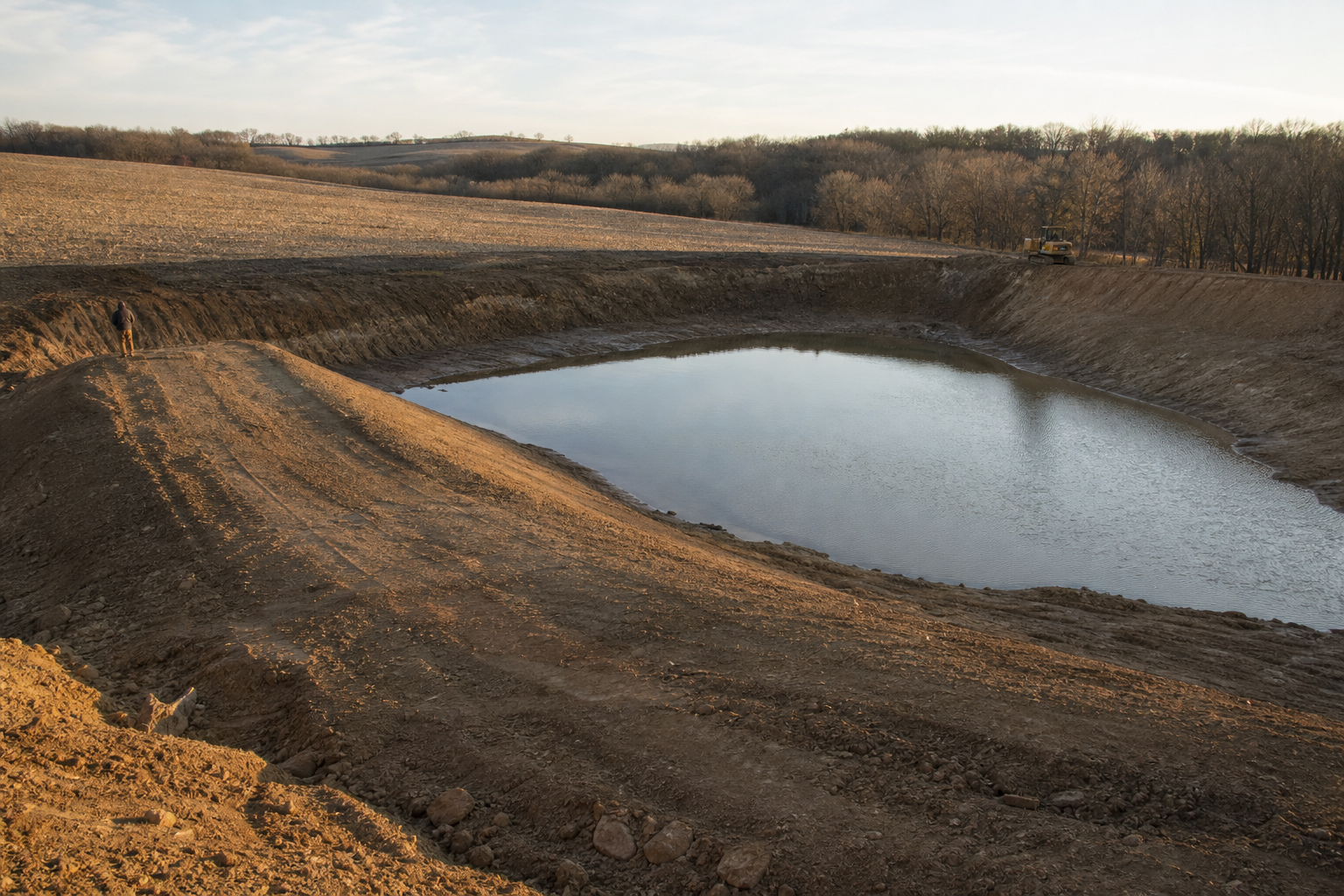
If you have been thinking about putting in a pond — or dealing with one that has silted in over the years — late fall is one of the better times of year to do it in western Illinois and eastern Iowa. Not because pond work is impossible in other seasons, but because several conditions line up in October and November that do not line up in April.
Why the timing works
Water tables are usually at their lowest. After a summer of crop use and evaporation, the ground is generally drier than it will be at any other point in the year. That matters enormously for pond work, because you are excavating into ground that you want to be workable. Digging a basin in the spring, when the water table is high and the soil is saturated, is a fundamentally harder job.
The crop is off. Access across fields is possible without damaging anything, and hauling routes are open.
Ground is firm. Fall soil conditions support equipment better than spring mud, which means cleaner work and less repair afterward.
Spring runoff does the filling. A basin completed in the fall is in place to capture snowmelt and spring rain. That is free water, arriving at exactly the right time, and it means a new pond can be substantially filled by early summer rather than waiting a full extra year.
Contractor availability. Post-harvest is a busy season, but it is not the spring crush.
What actually makes a pond hold water
The most common disappointment with farm and recreational ponds is simple: the pond will not hold water. That comes down to soil.
A pond holds water because the material forming its basin and dam has enough clay content to be effectively impermeable. Sandy or gravelly soil will not hold. This is why soil investigation before construction matters so much — test holes tell you whether the material on site is suitable, and whether there is usable clay available to line the basin if the surface soil is not.
Finding this out after the basin is dug is an expensive way to learn it. If the native material is unsuitable, the options — importing clay, installing a liner — add real cost, and it is far better to know at the planning stage.
The other structural essentials:
A properly built dam. An embankment is not just piled dirt. It needs suitable material, placed in lifts and compacted, usually with a core keyed into stable ground beneath so water cannot pass underneath.
A spillway that can handle a real storm. Every pond needs a way to pass excess water safely. This is the single most common failure point — an undersized spillway means water eventually goes over the dam, and water flowing over an earthen dam destroys it.
Sensible depth. Adequate depth reduces excessive aquatic weed growth in the shallows and matters for overwintering fish. What is right depends on your goals for the pond.
A watershed that fits. The area draining into the pond has to be large enough to keep it full and not so large that it overwhelms the spillway or fills the pond with sediment.
Dredging an existing pond
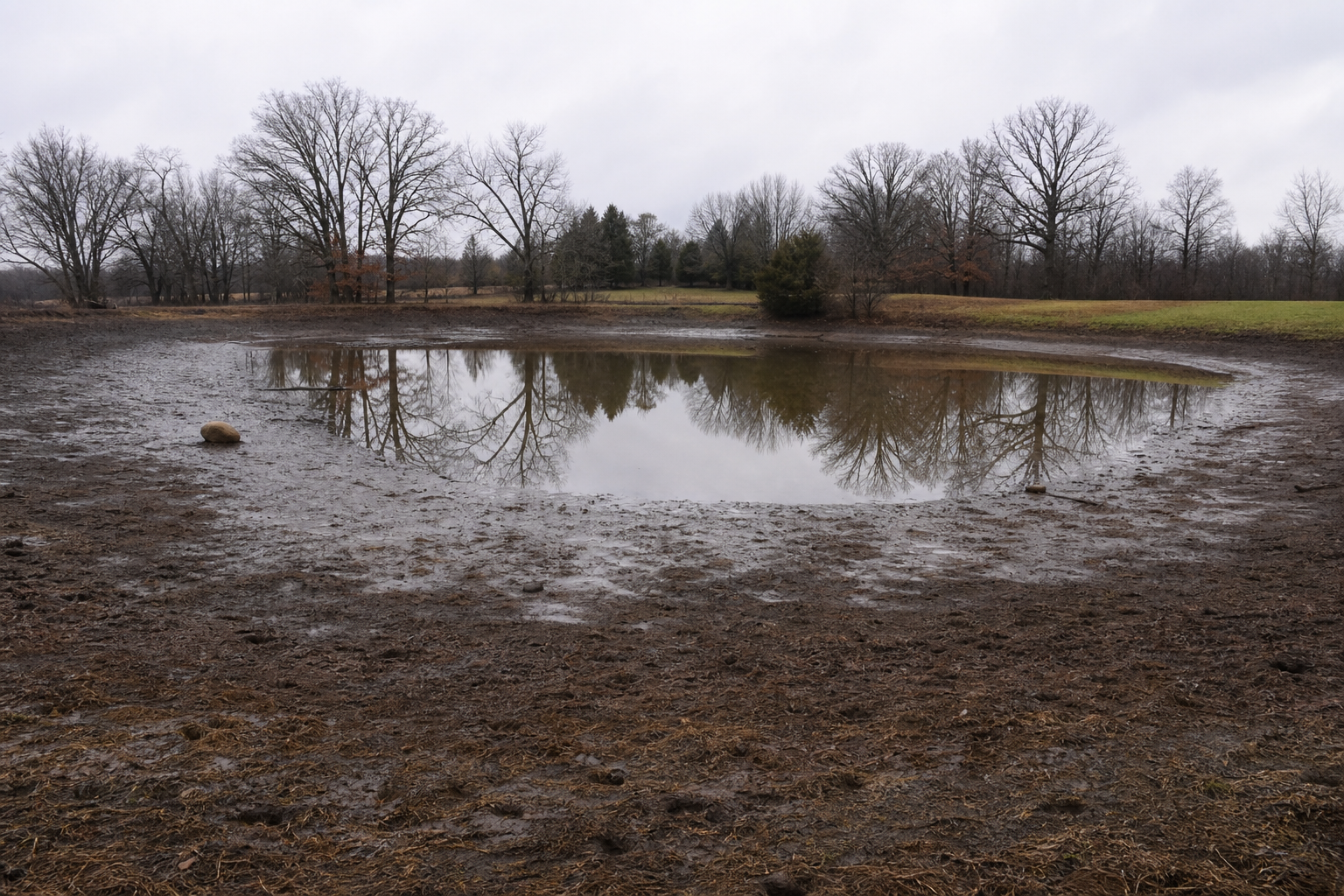
Ponds fill in. Sediment washes in from the watershed year after year, and a pond that was eight feet deep when it was built may now be considerably shallower, with muck across the bottom, heavy weed growth, and fish habitat that has degraded.
Fall is a good time for dredging for the same reason it is good for new construction: low water and firm ground. Some ponds can be drawn down and excavated conventionally, which is generally the more thorough approach.
Two things to plan for. First, spoil placement — you are removing a large volume of wet material, and it needs somewhere to go and time to dry before it can be spread or shaped. Second, the cause. If sediment is arriving from an eroding watershed, dredging without addressing the source means doing it all again. Grassed waterways, a sediment forebay or upstream erosion control may be part of the real solution.
Permits and rules
Pond construction is not automatically permit-free. Depending on location and design, work may involve local county requirements, state dam safety rules for larger embankments, and federal regulation if the work affects a stream, wetland or other water of the United States — the U.S. Army Corps of Engineers administers permitting in that area.
Building an isolated pond in an upland field is a different regulatory situation from damming a drainage way. The distinction matters, and it should be established before construction rather than after. Your county and the relevant agencies are the authority on what applies to your specific site.
It is also worth talking with your local NRCS office. They provide technical guidance on pond design and construction and may have conservation programs relevant to your project.
Before the ground freezes
Pond work is earthmoving, and earthmoving needs unfrozen material. Dam embankments in particular must be built with properly compacted lifts, and frozen material will not compact — a dam built with frozen chunks in it is a dam with voids in it, which is a serious problem rather than a cosmetic one.
That is the practical deadline. There is normally a solid stretch of workable weather after harvest, and it is worth using deliberately rather than discovering in December that the window closed.
Triple D Excavating Co. brings 25 years of experience in pond construction, dredging, drainage, land clearing, grading, road construction and septic work to landowners across Rock Island, Henry, Knox and Mercer counties in Illinois and Scott County in Iowa. If you are considering a new pond or restoring an old one, send us the details and we will walk the site with you while conditions are good.


AVOID COSTLY MISTAKES:
Do NOT hire an excavating contractor without first reading our free guide:
The ULTIMATE Excavation & Septic "Success Guide."

We Offer Septic & Excavation Services Near You!
If you don't see your specific area, contact us and we may still be able to help or give a referral.
Address: 3359 N 1300th Ave, Orion, IL 61273
Hours:
Mon - Fri. 7:00 am - 5:00 pm (Closed Sat & Sun.)
Extended hours by appointment only.


All rights reserved | Privacy policy